Thursday, June 18, 2026

I Lost $100 in Crypto—and Spent Hours Figuring Out Why


Last night I wanted to pay for my X Premium account with crypto, so I sent $100 USDC from my Coinbase account to my MetaMask wallet — and nothing appeared.

At least that's what I thought.

What followed was a frustrating reminder of one of the biggest obstacles standing between cryptocurrency and mainstream adoption: usability.

As someone who has spent years building payment, fraud, and digital asset products, I consider myself more technically sophisticated than the average consumer. Yet I still found myself spending a couple of hours digging through blockchain explorers, transaction traces, delegated smart contract authorizations, and token transfer logs just to understand what happened to a $100 payment.

The transaction itself was straightforward. Coinbase successfully sent 100 USDC to my Metamask wallet on Base. The funds arrived. However, almost immediately afterward, the funds were transferred out through a mechanism enabled by EIP-7702, a new Ethereum standard that allows externally owned accounts (EOAs) to temporarily delegate execution authority to smart contracts.

In plain English, my wallet had previously signed an authorization allowing another contract to act on its behalf. That authorization was later used to execute a transfer of the newly deposited funds.

What struck me was not the amount of money involved. Losing $100 is annoying but not catastrophic.

What struck me was how difficult it was to understand what happened.

The blockchain provides complete transparency, yet the user experience remains remarkably opaque.

The transaction history showed:

For an experienced product manager with a background in payments, fraud, and crypto, reconstructing the sequence took hours.

How would an ordinary consumer fare? The answer is simple: they wouldn't.

They would conclude that crypto is confusing, unsafe, and impossible to trust.

And unfortunately, many would be right.

For years, the crypto industry has focused on scalability, decentralization, tokenization, and interoperability. These are important technical achievements. But mainstream adoption will not be determined by transaction throughput or gas fees. It will be determined by whether ordinary people can safely use these systems without becoming blockchain forensic analysts.

Imagine if a credit card transaction required consumers to understand:

  • Smart contract delegation

  • Token approvals

  • Permit signatures

  • Account abstraction

  • Gas sponsorship

  • Cross-chain bridges

No payment network would ever have achieved mass adoption.

Traditional financial systems succeed because they hide complexity behind clear user experiences, strong fraud protections, and consumer safeguards.

Crypto still asks users to be their own bank, their own security team, and their own incident response department.

That model does not scale. So what needs to change?

First, wallets must do a dramatically better job explaining what users are signing. If a signature grants authority that could later move assets, the wallet should communicate that in plain language.

Not:

"Authorize delegate contract."

Instead:

"This approval could allow another party to transfer funds from this wallet in the future."

Second, delegation and account abstraction frameworks should include expiration periods, spending limits, and transaction-level controls by default.

Third, wallet providers should offer built-in monitoring and alerts that notify users when new authorizations are granted or when delegated contracts attempt to execute actions.

Fourth, consumers should adopt basic security practices:

  • Use separate wallets for storage and daily transactions.

  • Keep only small balances in hot wallets.

  • Review and revoke approvals regularly.

  • Avoid signing requests from unfamiliar websites.

  • Consider hardware wallets for larger balances.

  • Treat every signature request with the same caution as a bank wire transfer.

The irony is that crypto has solved many hard technical problems. Stablecoins can settle globally in seconds. Blockchains can provide immutable records. Smart contracts can automate complex financial workflows.

Yet the industry's greatest challenge may be something far more mundane: helping people understand what they're clicking.

Until crypto becomes safe and intuitive enough for ordinary consumers to use confidently, stories like mine will remain a barrier to broader adoption.

The future of digital assets won't be won by the next blockchain upgrade.

It will be won by better user experience, better security, and better consumer protection.

Monday, June 8, 2020

Alexa is Your New Guard Dog -- and Snoop

A new in-built skill in Alexa monitors your house for break-ins and emergencies while you are away.

There's no hiding from Big Brother  Alexa
Simply say "Alexa I'm Leaving" and the device will go into "Guard" mode. If the device hears the sound of breaking glass or a smoke alarm it will send out an alert with that message. Users can also playback the sound from their phone with that message.

If the homeowner uses ADT as a security company Amazon will also send an alert to them so that it can take action.

To enable the service Alexa uses the same acoustic technology as it does to monitor for its wake word (ie Alexa). This is a very novel use of technology, but it certainly opens the door for abuse.

For example police departments have been known to get warrants for recordings that Alexa has made, but now since we know that Alexa is listening in real-time I can imagine that the police could get a warrant to eavesdrop.

Forget about those movies where the police place bugs in your house or tap your phone -- we've done the work for them.

Sunday, June 7, 2020

Amazon Look is Discontinued

Smart speaker blog voicebot.ai is reporting that Amazon is discontinuing the Echo Look device.

The Echo Look was an Alexa-enabled smart speaker for fashion advice. Users could stand a few feet away and say, “Alexa, how do I look,” and it would snap a full-length photo capturing your entire attire. Then Amazon’s virtual fashion consultant “Style Check” would kick in and users could review their photos and feedback in the dedicated Echo Look app. It would recommend clothing options that could be purchased that match the users wardrobe. 

Echo Look's functionality is being incorporated into the Amazon Shopping app.

While its great that the AI feature is now going to be available to everyone, pity the people who bought the device and trained it on behalf of the company. Bezos gets to profit some more. 


Saturday, June 6, 2020

Alexa "Drop-In" Feature Becomes Intercom for the House

For those too lazy to find their family members in another room to announce dinner time or don't want to scream at the top of their lungs, Amazon has extended their "Drop-In" feature that allows a message to be broadcast to all devices in a house.

It's well known that some households have more than one smart speaker. Whether in the bedroom, dining room or kitchen smart speakers are proliferating around the home. People are even putting then in the bathroom (whatever happened to reading material).

So now anyone can invade every nook and cranny of a house with that important announcement.

You can read more about the feature from Business Insider.

Thursday, June 4, 2020

Amazon is Buying Your Old Echo Devices


Amazon Echo 
CNET reports that Amazon will let consumers trade-in their old Amazon Alexa devices. Depending on the model and type of device you can get between $5 and $30 plus 25% off of a new qualifying 

The original  Amazon Echo looks like a giant compared to the new generation product. My youngest son has inherited my device and uses it in his room. It's his alarm clock and audio-book player all in one (really the only thing that he listens to is Harry Potter).

My preferred Alexa device are the ear buds. I didn't really like these before compared to the Apple Air Pods but they've grown on me mainly because they stay in my ear without dropping out. What's interesting however is that I never use the Alexa functionality of the earphones.

Anyway back to the story, the buy-back program certainly is a great way for consumers to refresh their devices. I'm sure Amazon is ripping them apart for parts that may be still useable but more expensive to use from scratch

Wednesday, May 7, 2014

PayPal's Reaction to Departed Exec Required Better Appreciation of Mental Health Issues


Rocky Agrawal's public meltdown on Twitter this week attracted its fair share of rubberneckers who were perversely entertained by his five-day break from reality. Many in the virtual crowd of Silicon Valley workers, VCs and tech media pundits egged-on the fired former PayPal Director of Strategy as he manically tweeted insults about his former colleagues, and made wild claims about raising money for a supposed new venture coupled with six-figure job offers to people who could locate him in New York City based on his tweets.

Let me first disclose that I've known Rocky for several years. He hired me as a product manager at AOL. Seeing a friend and colleague fall from grace in this manner saddened me as I watched my feed in realtime. However I was more shocked by the callousness of PayPal in publicly firing him on Twitter and the lack of compassion of its CEO David Marcus towards someone who was obviously mentally unstable.  "I will not tolerate your mad rants any longer," wrote Marcus on PayPal's corporate blog claiming to defend the honor of his staff. But rather than exhibiting "Leadership" (the topic of his post) Marcus displayed what little regard he has for employees who breakdown in times of emotional crisis.

A bit of background for those not following this saga. Rocky was hired by PayPal a little over two months ago. He was a high-profile get for the company based on his two decades of product management experience for AOL, Microsoft and others.  He also appeared frequently on Bloomberg TV offering prescient commentary on the value of GroupOn and other second generation dot-com companies. For some reason on Friday night while he was on vacation in New Orleans Rocky started sending out obscene messages on Twitter about PayPal employees  (I don't think its constructive to repeat them) and others that were just plain gibberish.  He later claimed that they were supposed to be private direct messages written on a new Android phone that malfunctioned. On Saturday, PayPal fired back -- literally:


Rocky moved on to New York City and started to go into destructive overdrive:


Observers following the stream could plainly see what was going on: outbursts that broke through social guardrails, delusions of grandeur, and long periods without sleep all seemed indicative of a bipolar disorder and a manic episode.

According to the American Psychological Association, nearly 14 million  Americans suffer from bi-polar disorders -- almost half of them are, perhaps like Rocky, undiagnosed. Handling such employees can be extremely taxing for any HR department. "Some of the bipolar people can be your greatest stars and the biggest problems all at the same time," says Tom Wooton who has developed a series of workshops for employers on how to deal with bipolar disorders in the workplace.

Wooton advises companies that a bi-polar employee can be both a high performer - with lots of energy, creativity, and ideas - but also cause problems with coworkers or engage in risky behavior. Regardless, these employees have to be reasonably accommodated under the provisions of the Americans with Disabilities Act, and can't be easily fired (or forced to resign) if problems arise.

I don't know if Rocky had other problems with PayPal that caused such a precipitous reaction, but Paypal should have asked him to end his vacation and return to HQ once his insulting tweets started. In person the company may have been able to better assess the situation and helped Rocky decide whether he needed medical care. Instead it tossed him overboard and left him all alone without the company of friends or family to absorb the shock.

To truly add insult to injury CEO Marcus then declared in his blog posting that Rocky needed assistance but that it was someone else's problem: "Now...if you're a close friend of Rocky's and you're out there, I'd strongly suggest getting to him sooner rather than later, as his behavior is extremely worrisome. We at PayPal are putting this episode behind us, as always working on behalf of our customers."

Let me suggest to Mr. Marcus that there are millions of Paypal customers like me who have friends and relatives suffering from bipolar disorders or other mental illnesses. How you treat your employees is a good indication of how you will treat your customers when the chips are down -- which is to say not very well.

Update: I spoke to Rocky earlier this evening. First, his brother has flown in from San Francisco and is with him. This  is good.  Rocky insists he wasn't fired but had resigned by email before ever sending his epic tweets. The sequence according to Rocky has been  reported by Business Insider. Rocky is upset that PayPal's tweet was vaguely worded so as to give the impression that he was fired. Rocky says that he resigned because three executives who he respected had just left PayPal and he came to the realization that company's product was would never meet his own high standards. He felt that he could do better by executing his own vision so he fired off an e-mail on Friday night at 9:34 pm. He receievd an e-mail from his manager saying that they would sort it out on Monday morning. Howver it  seems that his nocturnal misadventures between Friday night and Saturday made this discussion moot.

My take is that Rocky's resignation,  his Twitter comments against PayPal employes, and his growing mania in New York cannot be viewed as isolated incidents. They are an escalating set of events that need to be looked at together in order to be properly understood. It did not help at all that PayPal poured fuel on the fire. I've counseled Rocky that he needs to take a break and with the help of a therapist he can start to undertand why his,  actions which make so much sense to him, caused the rest of us so much worry.

Thursday, January 3, 2013

Square Wallet at Starbucks Doesn't Work Very Well


Updated. Square’s wallet technology won a big endorsement when Starbucks decided to adopt it nationwide. In practice however using an ordinary credit card to pay for my daily cup of joe and pastry would be much quicker given the time I have to spend at the cash register teaching Starbucks’ staff how to use their own technology.

The Square Wallet is supposed to let a customer use their iPhone or Android smartphone to easily pay for their Starbucks purchase. After it’s downloaded from the app store the user inputs his or her credit card number into the app and Square stores it. Then when you enter a Starbucks location that accepts Square Wallet, the app geo-locates you using your phone’s GPS. After you select the store you’re in you can pay for your purchase by showing the QR code that appears on the phone’s screen. The check-out clerk scans your phone and you’re on your way – in theory.

In the two or so months since its debut I’ve tried using Square Wallet at a half dozen Starbucks in the New York City area. It hasn’t once worked like it’s supposed to.

First Starbucks barristas are often confused between the Square QR code they have to scan and the code generated for Starbucks’ own mobile app. I usually have to tell them that it’s Square that a want to use and then they have to step back and consult with their colleagues. One of these folks will remember that a separate button has to be pressed on the Starbucks cash register before Square can be accepted.

Then what I’ll call the “scanning dance” begins. Try as they might  barristas have never been able to scan Square’s QR image. Instead I have to slowly read out to them a 16 digit alpha numeric code that appears beneath the below the image. This error prone process causes everyone frustration.

People standing behind me in line glare since I’m standing between them and their coffee fix. The barristas aren’t happy because throwing them a curve ball that’s upending their happy task of mixing drinking. I’m of course fuming because everyone else is mad at me. It’s a circle of discontent. (Sometimes though it’s so busy that the barrista will give me my drink for free. This maybe an ironic incentive to use Square Wallet more often).

A spokeswoman for Square told me that the company is continuing to learn from its efforts and it's working closely with Starbucks to perfect the experience. Square hopes to introduce more features this year to make it even better.

One nice feature about the existing app is that once I make a purchase an itemized version of my receipt appears automatically and is stored with all my previous purchases. Besides saving a few trees, not having my pocket or wallet filled with crumpled bits of paper is a good thing.

Selecting a Starbucks location shows a QR Code that a barrista is supposed to scan, but often the scan doesn't work. I have to read out the alpha numeric number to the barista and sometimes I get a free drink because its too much of a bother. 


From the perspective of a consumer having a virtual wallet where the credit or debit card stored on my phone is a compelling proposition because it reduces the number of items I have to carry. Cash was replaced by plastic. Plastic may be replaced by a digital image (or radio waves travelling in the air in the case of NFC based technologies like Google Wallet). Payment for goods and services becomes frictionless.

However the promise of the virtual wallet will go unfulfilled unless there is mass adoption by merchants. Certainly Square and Starbucks are demonstrating the promise of things to come, but mobile payments will only be a brand associated novelty unless it becomes more widespread.

Given this, I wonder whether Square is rightly placed in the mobile payments eco-system for long term success? Does it become and acquisition target for another player or will it become roadkill as a result of a company that is better positioned. If Visa, Mastercard or American Express had mobile wallet services that would certainly make the service more available amongst merchants. Integration of Square Wallet at the device level by Apple (iOS) or Google (Android) would also make the technology more universal.

The Square Wallet has other features that Starbucks hasn’t rolled-out yet that make mobile payments unique. One service allows hands free payment by having the customers picture appear on the merchants’ check out screen. This way the consumer doesn’t even have to take their phone out of their pocket.

No doubt Square Wallet is innovative and its distribution with Starbucks gives it some heft in the marketplace,  but without nailing down the ability to consistently scan the QR code it’s a broken experience and creates more friction than it eliminates.

Update: Looks like this was fixed through a software update to the point of sales system. Starbucks reached out to me through Twitter after I posted this article for the addresses of the locations where I was having trouble. A couple of weeks later the location was able to scan. According to the manager he had to scan a new barcode into the system and in effect "teach" the system. Coverage is still spotty though because not all locations have received the code update.

Friday, May 11, 2012

60% of Yahoo! Workers Want CEO Scott Thompson Fired


My company WikiOrgCharts conducted a small survey of Yahoo! workers yesterday. Some of the results and comments are reported in this Venturebeat article by Rocky Agrawal. Nearly 60% of people who work at Yahoo! believe that CEO Scott Thompson should resign according to an e-mail survey of Yahoo! employees. A majority of workers also want Tim Morse, the company's CFO to assume the top job permanently.

The sentiment amounts to stark vote of no confidence from rank and file Yahooers of the new chief executive who was recruited months ago from Paypal. Thompson said on his CV and in Yahoo!'s fillings with the SEC that he had a Computer Science degree when in fact he did not.

“I'm appalled by the lack of integrity and honesty displayed by Scott Thompson who apparently isn't even willing to apologize for his misrepresentations,” said one respondent writing in a comments section that formed part of the survey. “All he aplogized for was the disruption this whole affair has caused thus far but not for the fact that he lied in the first place. ”

Other Yahoo! employees criticized the company's Board of Directors for allowing the situation to fester, “The subsequent lack of board action (or at least slow impending action) to remove Mr Thompson will demonstrate that we really do need a new board and new leadership that employees and industry can genuinely look-to for inspiration,” said another survey taker.

The attitudes and comments were gathered from 40 current Yahoo! employees who work at all levels
Goodbye Scott Say Yahooers
of the company and in a variety of positions who responded to the “Yahoo! Employee Happiness” survey. WikiOrgCharts.com is a web site I founded that allows users to build crowdsourced corporate organization. It conducted the survey by e-mailing more than 1,000 Yahoo! workers that are in its database. This exercise demonstrates another way we can gather corporate intelligence. By sides constructing org charts we can an inside view into what employees in a particular company are saying.

In addition to asking company employees about the fate of their fibbing CEO, repondents were also asked about who should succeed Thompson if he was fired and how long they themselves would stay at Yahoo!.

The majority of Yahooers surveyed, 41%, said that CFO Tim Morse should be made the CEO. Morse held the reins at Yahoo! temporarily this year when the company's Board of Directors dismissed then CEO Carol Bartz. If he doesn't want the job insiders are rooting for Ross Levinsohn Yahoo!'s Head of Global Media. Also suggested was Dr. Werner Vogels, CTO of Amazon.com – someone who does have a CS degree.

Yahoo! Workers Want Out
In terms of their own tenure of the company, nearly half the workers say that they are headed for the exit door. Twelve percent of those surveyed said they planned to leave the company this month. Another 36% of those surveyed expected to leave Yahoo! within a year. The remainder said that they planned to leave within two to three years or that they had not plans to leave at all.

Notwithstanding the negative sentiment Thompson has his supporters. “The media is blowing this out of proportion,” said one repsondent. “Leave Yahoo! Alone.”

Thursday, October 6, 2011

Some Thoughts on Steve Jobs


It was fitting that I learned of Steve Jobs' death while I was at the Silicon Alley Insider 100 party tonight on the trading floor of the NYSE. There, amidst banks of phones and screens where billions of dollars are traded each day, a very large subset of NYC geeks who matter were all looking at monitors that announced the news of Apples founder and expressed their sadness to each other about the loss of a technology giant.

I never met Steve Jobs, but I did see him in the flesh when I attended Apple's World Wide Developer's Conference (WWDC) in 2008. That conference was notable for being the first one after the introduction of the iPhone. I have to say that when he came onto the stage I was shocked. Instead of the youthful looking Jobs I had seen in many pictures he looked extremely gaunt and frail. I remember the rest of the audience was shocked as well. The company's stock dipped that day and the story in the media was not about all the cool things that Apple was doing but about the health of its co-founder. That's the day the Jobs health watch began.

---

I am an Apple fanboy, and my love for computers was influenced by Steve Jobs and the machines he designed. I saw my first Apple computer when I was in the third grade. There were three Apple II Plus machines that sat on some library tables. We were told not to touch them, but I was fascinated. They eventually went to the guidance counselor’s office (lucky him). I found a book that had simple basic programs and got permission to the office to use the computers. I spent many hours trying to type in a complete program to make the rocket created in ASCII characters fly. The problem was lunch time wasn't long enough to complete the task so I had to start over every time. No one told me about something called a floppy disk.

The II Plus was succeeded by the Apple IIc. This computer was really beautiful. I remember it was nicely designed white machine with a chiclet-style keyboard. Today we speak of the digital haves and the have nots. One of my elementary school classmates was a digital have. His parents had the foresight and money to buy him one of these machines. I was a have not. The IIc was not in our family's budget, and so whenever we went to his house I wasn't really interested in playing with him -- I just wanted time on his machine.

My first computer was a DEC Rainbow. It was a gigantic machine and ran on MS-DOS 2.0. I got it as an obsolete hand-me-down for the doctor my mother worked for. I was appreciative, but it was not an Apple. I enjoyed exploring the PC world, but the problem with the DEC was that it was completely useless for school work because its programs were incompatible with those used on other PCs. So most of my assignments were typed PCs as my mother's office, at libraries, or at school.

The PC would dominate my life for the next 20 years. In college some students had Macs which could produces documents with nice fonts, but I used the PCs in the computer lab. When I finally purchased my own machine it was a PC because I could save my work and use the lab's printer. As I went to work, employers gave me PCs. Apple seemed to be for designers.

Apple and Jobs didn't really enter into my life again until I was in my mid-30s. I have never owned much music so the iPod completely passed my by. My re-introduction to Apple occurred through the iPhone. The moment I had it in my hands I knew the iPhone was miles ahead of any other so-called “smartphone.” The combination of hardware design and the software was incredible – and still is.

Unlike many commentators I don't think Jobs single-handedly designed any of the great products we associate with Apple. To give him such credit is to put him on a pedestal too high. (After all Wozniak soldered the components of the first Apple machines, and many specialized engineers and designers worked on later products.) What we can credit Jobs' with is in having a vision of how these machines and software should work. He had the opportunity and power to bring talented people together and motivate them to work to his high standards. He had sign off authority and he used it time and time again. Other executives would have shipped substandard products but Jobs wanted perfection – or at least as close to it as he could get.

I now have a complete set of Apple products: a MacBook Pro, an iPhone, and an iPad. I spend almost half my waking hours (maybe more) every day using one of them. As I use them I find “joy” because I can use them to express myself, learn or entertain myself in an unencumbered fashion. That is Steve Jobs' gift to me and to all of us.

Thursday, April 8, 2010

Apple Ups the Ante with OS 4


Apple held a news conference today to announce several enhancements to the iPhone operating system. This fourth generation of the OS will include:

Multitasking: One of the biggest gripes about the iPhone is that it only allows access to one application at a time. Now if developers integrate the new APIs several applications run at once. In addition if you’re using an application like AOL Radio or Shoutcast you can start using another app and the music will continue streaming. The same can be done for location. Instead of shutting down Mapquest and losing navigation, the iPhone can continue accessing location and providing turn-by-turn directions. Finally VOIP applications like Skype can also function in the background so calls can be received even if Skype isn’t running.

Another feature related to multitasking that was discussed during this segment was “push notification” and “local notification.” In lieu of multitasking Apple had devised a system in which an application could send a user a SMS-type alert even when the application wasn’t running. This was useful in apps like AIM where messaging was occurring in real time but it wasn’t practical to keep AIM running all the time. Now rather than relying on Apple’s servers for this feature, notifications can be run off of developers’ own servers.

Multitasking will be available for the iPhone 3GS and the third generation touch but not for second generation devices. (If you are a first gen user doesn't look like Apple is even targeting these handsets anymore).

Game Center: Here Apple is taking direct aim at Nintendo and Sony. There are more than 50,000 games available for the iPhone (out of 180K apps total). Apple is upping its support of gaming by creating APIs that allow users to invite their friends to play a game and allow for matchmaking between all users of a particular game. Additional APIs allow for leaderboards and achievement lists.

iAd: Through its recent acquisition of Quattro wireless, Apple will begin to challenge Google in the mobile display ad marketplace. Apple’s premise is that users spent 30 minutes a day using apps on the iPhone. By integrating a user friendly (oxymorn?) ad format and app-like functionality it can turn mobile advertising from an annoyance to something tolerable – maybe even entertaining for users. In a clever bit of cross promotion Apple showed an ad for Disney’s Toy Story 3 (Steve Jobs sits on the Disney Board) which included a video in the HTML 5 format (diss to Adobe). Currently technology from AdMob and Millennial Media force the app a user is using to shut down. The new iAds allow for display within the application itself. Apple will be splitting ad revenues with the developers 60/40 (in the developers favor) and hopes that this will encourage the monetization of free apps.

Folders: OS 4 allows users to organize their applications into folders. This essentially expands the number of applications a user can have on his device. Previously an iPhone was limited to displaying 180, now its 2,130. A folder is created by moving one application over another and naming a folder.

Unified Messaging: The mailbox feature in the iPhone let you set up multiple accounts but each one had to be looked at separately. The unified messaging feature allows mail from multiple sources to be mixed, including supporting multiple exchange servers. The option to have messages threaded will also be supported. Finally attachments to mail can be opened with apps that are resident on the iPhone.

iBooks: The iPad launched this week with a new e-book reader and store called iBook. It’s currently not available for the iPhone but will be as part of OS 4. Now you can get your free Winnie The Pooh book too.

Enterprise: The iPhone is not only a consumer device. According to Apple 80% of Fortune 500 companies use iPhone in the enterprise. OS 4 builds in better encryption, better device management, support for multiple Exchange servers and other features that will make life easier for IT administrators and make them less hostile to the notion of letting iPhones on to their networks. Obviously Apple is going after RIM here. There are many people I know who carry both an iPhone and a Blackberry. As Apple incorporates Enterprise support the need to carry that other phone lessens.

Given the above there was obviously a lot packed into today’s announcement but there still seem to be those with a vested interest in Flash that seem to be grumbling. For example I received an e-mail from Dominique Jodoin, President and CEO of Bluestreak Technology which bills itself as the 2nd largest provider of embedded Flash solutions in the world. Jodoin says, “Until the iPhone supports Flash technology, like most other wireless devices do, and, specifically, many competitive Android-powered devices, it will never offer a complete data services experience to consumers.”

I’m not so sure I would agree. There are 75 million iPhone/iPod Touch/iPad users in the world. Even though an awful lot of content companies use Flash they will be forced to use HTML 5 in order to cater to this large user base. If they start doing that and web browsers also adopt the HTML 5 standard, then developers will start to abandon Flash.

So in the short term while Jodoin may be right, he’s playing defense to Apple’s juggernaut .

Tuesday, April 6, 2010

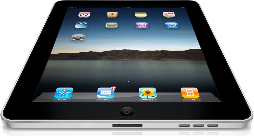
My Initial Thoughts on the iPad


I got my hands on an iPad yesterday morning. I had originally pre-reserved one but ended up on a family ski trip over the weekend so a friend picked it up for me.

My 9-year-old son enthusiastically opened the box. After admiring sleek design for a few minutes he summed it up thus: “It doesn’t have a camera and it doesn’t have a phone.” I had to explain to him the rationale of buying a first generation WiFi only version.

My 6-year-old daughter also bounded up the steps to get her hands on Dad’s new toy. Her takeaway: “It’s like your iPhone only much bigger.”

That just about sums up what most professional reviewers had to say about the iPad, but wait there’s more…

Form Factor and Connectivity

The iPad is slightly larger than a paperback book and weighs about 1.5 pounds (I have a 16GB but found that the 64 GB was a bit heavier). It’s also heavier and bigger than the Amazon Kindle.

With these dimensions the iPad is not something you casually carry in your hand as you walk down the street. This is definitely a device that you use sitting down in a chair and consume media.

Besides the bulkiness there is a sense of fragility. I get the sense that phones are designed to withstand a few drops. The feeling I got dropping an iPad was akin to dropping a baby (No I haven’t dropped any of mine) – the horror I felt compelled me to buy a case for it immediately.

When I initially considered the prospect of buying an iPad I was convinced that 3G connectivity would be unnecessary, however I’m beginning to have second thoughts about this assumption. I really got to use it the first time on my train trip to work. As I sat rolling towards NYC I realized that I couldn’t read the New York Times or check my email, things I was used to doing on my iPhone. Even in WiFi hotspots there may be problems. There are some reports circulating about poor connectivity. I experienced this myself at my office in NYC, but that may have been due specifically to the quality of reception in that space. One of the best things about the iPad is the batter life. I used it yesterday continuously for 12 hours and I still had juice left. In contrast my iPhone dies after a few hours of use.

Applications

The iPad is all about the screen. The 9.7-inch LED-backlit IPS display on iPad makes everything pop. Unlike the iPhone I don’t believe that websites need to be customized for this device except to mitigate the lack of Flash support. Regular web sites show up just fine albeit a little smaller.

As for native applications certainly with a larger screen, the UI for many apps can be altered to take advantage of the larger canvas. As such the interface can be made much richer and easier to use.

Although iPhone apps can be used on the iPad they appear in their original iPhone size shape. They can be magnified, but I found that making these larger pixilated the text and you could definitely see a marked quality difference between iPhone and iPad applications. This means that serious developers will have to create separate iPhone and iPad versions, not to mention Android and desktop. That’s a lot of development effort and one that should be rationalized (ie. Publishers should ask themselves

Ultimately the bigger screen size means that the content experience will be richer. One free app that I downloaded, A Story B4 Bedtime, displays children’s stories. The narration is recorded via webcam by parents, and the book and video/voice track are bundled up. (Presumably this is for kids to use when their parents are traveling but I could see publishers distributing versions read by authors.)

Another app that I thought took advantage of the screen was a comic book reader from Marvel. The Hulk and the Fantastic 4 never looked so good backlit.

iPad vs Kindle

I also downloaded the iPad Kindle reader and so I could continue reading Ken Auletta’s “Googled,” which I had started on my iPhone (in sheer coincidence his literary agent was sitting next to me on the train). The larger screen meant I didn’t have to hold the device up to my nose. Apple also has a books app called iBooks. “Winnie the Pooh” is a free download and shows-off the iPad’s superior features.

The first think you notice is that the books available on the iPad can have color pictures just like real books. That’s infinitely more entertaining than page after page of gray text. Second, with a flick of a finger the iBooks reader simulates the turning of a page. No more Kindle flash. Both features make iBooks a much natural reading (and learning) experience.

The multi-purpose nature of the iPad ensures that it is a Kindle killer. The latter is a one trick pony while the iPad is a swiss army knife.

Rafe Needleman of CNET has an in depth look at the issue and feels the opposite, but the shortcomings of iBooks are only temporary and will be bridge by the time the next version of iBooks comes along.

The Takeaway

Even though it debuted at $600 the iPhone was a utilitarian device which exposed millions Americans (and the world) to the notion that a phone could be much more than a phone. In contrast, even with its benefits, the $500 iPad is an expensive toy for the media consumer. It offers convenience and a better experience. It doesn’t necessarily solve a big pain point or create a new need.

However the price point will decrease over the next year, and as it does more and more people are going to buy one to complement their iPhones.

Additionally the bigger market for Apple may exist among the 19 million high school and college students. Once they start getting their course material (and movies, games, and web surfing) on one device that will create a very large user base for Apple

Tuesday, March 23, 2010

Software Helps Parents Monitor/Control SMS Usage

I saw two companies at the Showstoppers event in Las Vegas tonight that are trying to make sending SMSes on mobile phones safer. TextArrest prevents teens from sending text messages while driving, and Smobile helps parents monitors the child's text messages for inappropriate content.

Texting is big in the US. Nearly 161 million Americans have sent text messages on their mobile phone, and among young people 82% under the age of 25 use text to communicate. Inevitably problems can and do arise.

There have been many instances in which drivers -- not just teens -- have been distracted while driving causing horrific accidents. Additionally the phenomena of sexting -- the sending of sexually suggestive pictures and messages has received national attention. Cyberbullying can also be a problem.

TextArrest is a downloadable application that uses the GPS in a smartphone to detect when a person is travelling more than 5 miles per hour. It then locks down the screen of the phone preventing messages from being seen or from being written. Passengers can override the system, but all such attempts are logged. Using web based software a parent can detect when their child turned the system off.

Smobile tackles the other part of the problem by providing for the parent a copy of every SMS or picture that was sent on the phone its installed in. The web based software also detects when inappropriate words are used like beer or naked and alerts parents. The software also scans pictures.

TextArrest costs $4.99 per month for up to 5 family members. Smobile costs 29.99 for a single installation

Tuesday, February 9, 2010

Mobile Bar Codes are Here


This morning while on Metro North I found my self staring at a big poster of semi-naked Sports Illustrated swimsuit model Brooklyn Decker. Since I’m an unemasculated male the first thing I noticed of course was Decker’s curvaceous body, but then the geek side of me kicked in and I noticed the 2D barcode next to her.

Of course I knew what to do. I took a picture of the barcode with my cell phone’s camera and sent the picture via MMS to a short code printed on the poster (of course I could have also sent the barcode pic by e-mail). Moments later I received a message back from Sports Illustrated with pics of 6 other clothing challenged models who appear in this month’s Swimsuit Edition.

I’m not sure how many commuters knew what to do or how many actually participated in SI’s campaign, but the high profile presence of this ad and the fact that literally everyone has a cell phone capable of taking pictures and receiving web-based information means a a lot more tags will start appearing on advertising and other everyday objects.

SI’s campaign was powered by JagTag, a New Jersey, based consumer marketing company. JagTag has a unique technological offering which allows users to read barcodes without having to download a special reader. It was really easy to take the picture and get the content returned. (Of course convenience comes at a cost because both the user and advertiser pay the cost of an MMS message. More ARPU for carriers!).

On the downside it seems that JagTag doesn’t have a self-service option. If I wanted to create and distribute a tag I’d have to have a relationship with JagTag

Microsoft on the other hand, which also has a tagging project, does allow anyone to come in and create a tag. It also has some rudimentary business intelligence tools that allow tag creators to see how frequently their tags were scanned. On the downside, Microsoft’s offering requires the download of a proprietary barcode reader. They have one for the iPhone.

What’s neat about both the JagTag and Microsoft tags is that instead of an undecipherable Rorchach-test pattern, the barcodes can be fashioned to look like images users are familiar with. A bikini clad woman in SI’s case or a graphical overlay in Microsoft.

But I suppose in the future we can expect to see information embedded directly in an advertising image. Taking a picture of it will automatically redirect users to a site with additional information, or maybe it will send a user a mobile coupon to try that product.

That’s certainly something that Target Store’s is banking on. According to a story in Gomo News It’s recently launched an effort to install mobile barcode readers in all of its stores. Now instead of bringing their target customer loyalty card with them every them they come to shop, Target customers can present their phone and have their loyalty card scanned-in in the form of a 2D barcode.

Wednesday, January 27, 2010

The iPad Unveiled -- My Thoughts


For those of you who are into mobile and technology, today was the momentous day when Apple unveiled its iPad tablet device। A group of us at AOL's NYC office gathered in a conference room to watch the event live and experience the moment together on Justin।tv (There were 114K concurrent viewers which is about as much as MSNBC on a good day).

I am not going to go over the iPad feature by feature, I’m sure sites like Engadget and TUAW (The Unofficial Apple Weblog) will cover in great detail। Instead I want to focus on the implications of this new device.

The iPad is basically a giant iPod Touch, but it's a device gets the computer out of the way for the ordinary American consumer. It’s a nice size and weights about a pound. The price starting at $499 is aimed solidly at the middle class and will surely come down in its 2nd and 3rd iterations. I travel daily on Metro North and see hundreds of iPhone users amongst millions worldwide. These users will naturally gravitate to the iPad as a complementary device that they will use for infotainment at home. Apple is establishing a lifelong relationship with them and they will spend million and millions buying content.

The Kindle is dead. Early reports indicate that the iPad has a much nicer more readable screen. Besides the fact that it is in color and that it does more than read books. Add to that that Apple has launched the iBook bookstore it is now directly challenging Amazon and Barnes & Noble in the selling of electronic media. Apple has basically chased Amazon and certainly B&N out of the hardware market.

Apple is releasing the WiFi version first followed a month later by the 3G version. I see no reason why users would wait and pay more for 3G (plus the monthly fee).

From an applications development perspective it seems that the iPad is running the standard iPhone OS (There may be some iPad specific API calls in the SDK). It runs all iPhone applications out of the box, but customized applications (like the NY Times which was shown) would look better. As a result of larger screen however newer interactions between people sharing the device will result in new forms of applications. The form factor of the small screen mobile device has been broken so it is possible to create a app that could use a bigger screen. How about watching live streaming TV and AIM at the same time.

All in all, just like the iPhone I think the iPad will gain an audience among a large section of American consumers. My search colleague Oscar Kafati pointed out that there are over 15 million college students in the US. Imagine everyone toting an iPad instead of a laptop and having their college texts available on them. It will happen.

Thursday, February 26, 2009

Twitter Makes Me Smarter


Even though I've been aware of Twitter for the past 2 years, I've been using it in earnest only in the past couple of weeks. As I've tweeted and followed people something amazing has happened -- I've become smarter.

One way really smart people succeed (I'm conceited enough to consider myself somewhat smart) is that they surround themselves with smarter people. The smart person, even one who is an expert in his own domain, realizes that there are people out their who know more. The smart person is open to new ideas and he tries to leverage the experience of others.

One distinct downside to the "smart people" strategy is that you have to be in a place where you can encounter the smart types. Further you have to work at cultivating personal and professional relationships over time so that you can build a useful network of smart people. Such things require careful planning, social skills, and a bit of luck of being at the right place and the right time. I tend to fall short in all three areas.

Twitter however has captured the imagination of some of the Internet's leading thinkers and entrepreneurs. They're all seemingly happy to share in realtime their thoughts, ideas, interests, what they're reading, and where they are.

My new "friend" Steve Case, the founder of AOL and former Chairman of AOL Time Warner, has ordered the new version of Amazon.com Kindle book reader; Kevin Rose, the co-founder of Digg is fascinated by speech-to-text software created by AT&T Labs that produces natural sounding voices; and Joe Trippi (Howard Dean's campaign chief) is passionate about democracy in Zimbabwe.

Through Twitter I'm learning about venture capitalism from Fred Wilson; the inner workings of Google from Matt Cutts, and Kara Swisher is keeping me up-to-date on what she's finding out interviewing Silicon Valley executives.

Many of these people on Twitter are letting their guard down and being themselves. Since most people let anyone follow them there is a social contract of sorts that exists in Twitterverse that people will treat each other with mutual respect and not misuse people's tweets. Will this last or will one Twitter scandal cause people to retreat back into their offices? I hope not, but in the meanwhile I feel privileged to be sharing the thoughts of some of the Net's brightest minds.

Thursday, January 8, 2009

The Big Whopper Flameout

It started with so much promise and ended with a flame-out.

Burger King had a cool idea in its new Whopper Sacrifice campaign: a) install an application on your Facebook page b) sacrifice/remove 10 of your friends from your social graph c) get a coupon for a free whopper.

The strategy shows that Burger King (or at least its ad agency) totally gets Web 2.0. In fact I would even call the execution brilliant. The notion of deciding which “friends” to eliminate turns the whole social networking idea on its head. Even better as you sacrifice “friends” Facebook’s newsfeed lets the world know which victims don’t make the cut.

And then the big let down. First to claim the coupon Burger King makes you fill out a form that asks for everything but your first born’s left foot. Name, Cell Number, E-mail address, Postal Address, Gender. Come on guys isn’t the fact that you have access to my Facebook profile enough?

But here’s the real kicker. After all that work BK tells me that my coupon will be delivered in two to four weeks. WTF?!

How could people who came up with this great idea be such morons?

Users of online media want immediate gratification ie. a coupon on the web screen, via e-mail or on SMS. Telling me that a coupon will come in a month is outrageous and ridiculous.

The Whopper may be flame broiled but someone’s brain at BK is fried.

Tuesday, October 14, 2008

No More Talking/Texting While Driving

Agence France Press reports that a Canadian company, Aegis Mobility, has created new technology called DriveAssist that intercepts phone calls and text messages while a person is driving.

DriveAssist uses GPS and other technologies to detect if the person is moving at a speed which indicates he is in a car.

Many jurisdictions like New York and Connecticut forbid talking on a cell phone while driving without a hands-free device like a speaker phone or bluetooth headset because of distractions associated with such activity. Even this restriction however isn't foolproof because one still has to look at the screen to dial.

Smart phones such as the iPhone complicate matters because I often look at Google Maps and directions while I'm driving.

I think DriveAssist is a good feature. Unfortunately it is being offered on a carrier-by-carrier basis for a monthly fee.

I think that this creates a potential legal problem for carriers and handset manufacturers. If blocking calls from those that are driving is considered a safety feature then not including it in a phone or service plan for free may be considered a product defect.

As such carriers/manufactures may become liable to those who are injured by customers who used phones that lacked such blocking features.

Obama Advertises in a Video Game


Campaign ads for presidential candidate Sen. Barak Obama are appearing in the the video game Burnout Paradise.

Roadside billboard advertising in the real world is nothing new. Images stay with us as we cruise down the ashphalt highway. I think the impact is even greater in a video game because players are more engaged with what they are seeing on screen.

Obviously there are people at the Obama campaign are really thinking about how to engage with younger voters.

In game ad revenue also is a smart move by game publishers. GigaOm confirmed with Electronic Arts that the Obama campaign purchased the spots through them.

As a parent who recently purchased a Wii for my son, I wonder though how I would feel about ads for McDonalds or other companies appearing while my son is playing Wii Tennis? Kids are marketed to too much already, and there need to be some areas that are just ad free.

Perhaps in the future we'll be seeing games being sold in ad-supported and ad-free versions. The latter costing a little bit more of course.

Monday, August 25, 2008

No 3G For Me!


Riding the Metro-North train into New York City one morning I spied a fellow commuter reading the New York Times. My attention was drawn to an AT&T Wireless ad for the iPhone. "Half the Price. Twice the Speed!," it proclaimed.

Yeah right, I said to myself as I turned my attention back to the screen of my Jesus phone that was still struggling to download a page over 3G even though I had full bars. So much for walking on water, I was having a better experience when I was on the EDGE with iPhone 1.0.

The slow experience has been widespread, and to be honest I haven't personally noticed any improvement from Apple's 2.02 firmware upgrade.

In this vain a couple of articles caught my attention this morning.

First the folks at Wired have come out with a nifty study that assesses the speed of various 3G networks worldwide. Wired gathered data from 2,636 participants (1,638 were in the United States). They found that European T-Mobile users reported the fastest 3G Download Speeds: 1,822 Kbps on average. In the U.S. AT&T was puttering along at 990 Kbps.

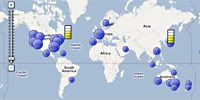
For those who are more visually minded Wired teamed-up with Zeemaps to create a Google Maps mash-up to show their respondents in clusters and provide signal strength indicators by geography. (The map has been so popular that it's taken down Zeemaps).

The problem it seems is not device related. All Thing :D citing a Reuters story reported this morning that the Blackberry Bold is experiencing similar sluggish speeds on the AT&T network. According to Citi Investment Research analyst Jim Suva, "There were a few occasional high-speed signal-dropping problems, especially on streets with tall buildings. The handset's EDGE network capability immediately picked up the signal, but at slower Internet speeds."

Still, Suva's analysis seems qualitatively based. A more scientific analysis is offered by Sweden's Bluetest which sells test chambers for wireless devices. In comparing the antennas of the iPhone, Nokia N73, and the Sony Ericsson P1. The test found that there was substantially no difference in the quality of reception between the devices.

The problem thus seems network based. Watch out AT&T! The sharks will surely circle.

Thursday, August 14, 2008

AOL Mobile Search Grabs a Silver

The folks at mocoNews.net awarded AOL Mobile Search a Silver medal today in a faceoff against other search engines for the query term "Olympics". Google and Yahoo tied for Gold and MSN got a bronze.

The key differentiator seems to be that Google and Yahoo show medal results and ranking while AOL doesn't. On the other hand AOL showed Olympic themed ringtones which we get source from Thumplay.

I think MocoNews' point is well taken. Ideally the recipe for the term "Olympics" should be Medal Results, News, News Pictures, Web Sites, Mobile Websites.

This is an awful lot of content to fit on a page but as mobile browsers become more full featured I can see mobile "One Clicks" being developed in the same way that AOL services such content for the desktop search.

In the meantime I'm glad we beat out MSN and have a good target in Yahoo! to shoot for.